I received this book as a pre-print from the publisher, Plough. It has been a while since I have read a poetry collection and I thought that expressing poetry in graphic novel format is an interesting idea. As it turned out I generally liked the book, but I liked some treatments of the poems better than others. I preferred illustrations that did a literal depiction of the poem instead of trying to tie in symbolic meaning. If a poem has veiled symbolism, one of the charms of reading the poem is trying to figure out the symbolism, or maybe trying to find personal meaning in the symbolism. The artist, by depicting his symbolic interpretation of the poem, steals from me the experience of creating my own interpretation. That being said, if I were a high school student and needed to interpret a poem and found this graphic novel version on it, I could be pretty excited about it. I actually think teens, particularly English/reader nerd types, are the perfect target audience for this book. I could also see a high school teacher using one of these illustrated poems as a springboard for a good discussion. If I were a high school English teacher, I would definitely want a copy on my classroom shelf. (2026, 141 p.)
Showing posts with label Poetry. Show all posts
Tuesday, December 16, 2025
Nature Poems to See By: a comic artist interprets more great poetry (illustrator) Julian Peters (Net Galley)
This is a collection of 24 famous poems that have been illustrated or presented in the style of a graphic novel. The poems are arranged by seasons, with six poems for each season, and most would be familiar to anyone who has ever studied poetry, like "Shall I Compare Thee to a Summer's Day" by Shakespeare, and "Stopping by the Woods on a Snowy Evening," by Robert Frost. Peters seems to make an effort to include poems from different time periods and a few different cultures, though most are from Western authors. Some of the illustrations are more like graphic novels, with one frame per each couplet, while other seem more like true illustrations, with a lot of words associated with one picture. Some of the poems are illustrated literally, and in other cases Peters tries to suggest symbolic meanings implied by the poems. At the end of each graphic novel depiction of a poem, the poem is also printed in traditional font and format.
Friday, June 28, 2019
Long Way Down by Jason Reynolds
This book in free verse starts when Will sees his brother, Shawn, get
shot on the streets of an inner city. As he is left by himself to deal with his grief he remembers "the
three rules"; don`t cry, don't snitch and get revenge. He manages the first and the second, and tries to steel himself to do the third. He believes he
knows who killed his brother so he finds his brother's gun and gets into
the elevator to go out and do the deed. As he starts down
the elevator door opens on different floors admitting people from Will's past
who all died through gun violence. As they tell their stories the reader
sees the senseless loss that results from following "the rules".
This
is the first time in a while that I finished a book and had to say
"Wow!" I have enjoyed several Jason Alexander books before but this one
was Amazing! It has such a powerful message written in totally
accessible language. It is rich in imagery too. This is one an English
teacher could really sink her teeth into.
I
actually saw Jason Alexander speak just last week as the keynote at the
ALA conference opening session. That talk was also totally awesome.
So, I guess Mr Alexander is on a roll. (2017, 320 p)
Friday, January 5, 2018
One Last Word by Nikki Grimes
It is not so hard to
Think of what your
Parents would do, but your own
Actions are a reflection of self
Not what your parents want you to be
So you must decide which you is true.
(I just made that up, it is not from the book)
Grimes explains in an author's note that this form of poetry is call "Golden Shovel." I must admit I wasn't that impressed at first. I tend to like poetry with more rhyme and meter. As I read the collection, however, I began to realize that Grimes had put a lot of wisdom and hope into the poems. Many of the poems are directed specifically to a black audience, but have a message of self acceptance that is applicable to anyone. I also really liked the illustrations that appear with each poem. They are by a variety of the most prominent African American illustrators. All in all, I don't know how much readership this collection will have in my community, but I am not surprised that it has received a lot of national acclaim. (120 p. 2017)
Thursday, December 7, 2017
I'm Just Not Good at Rhyming by Chris Harris
(Carol, I if you still read my blog, Ghetty would love this book.)
Friday, December 1, 2017
Out of Wonder by Kwame Alexander et alii.
Actually I am thinking it is a contender for Caldecott as well as for Newbery. The illustrations bold and colorful and do a good job of suggesting the time period and personality of the featured authors, while still maintaining a common thread the holds the book together. (40 p. 2017)
Tuesday, February 7, 2017
Freedom Over Me by Ashley Bryan
Wednesday, July 27, 2016
Neon Aliens Ate My Homework and Other Poems by Nick Cannon
Thursday, August 20, 2015
Brown Girl Dreaming by Jacqueline Woodson
Monday, May 25, 2015
Crossover by Kwame Alexander
This book won both the Newbery and the Coretta Scott King honor award this year. I always try to guess the winner each year, but this one came out of the blue. I thought for sure Rain Reign would win because it was the first book to deal well with autism. I am so glad this one won instead. This book is a gift to teachers, librarians and reluctant readers. The book is written in free verse, but much of it is basically written in rap and it is really well done. Imagine what we used to call a "jock" (do they use that term anymore? Am I dating myself?) who is assigned to read a Newbery winner. The poor kid has never read a full length novel in his life, but pours over copied of Sports Illustrated. The kid rolls his eyes and sighs, but the librarian says, "I have the book for you." So the kid gets the book, looks at the cover, and shrugs. His mood changes from "oh no" to "ok" and he starts to read. Soon he is talking about the book to other kids on the team and showing them parts. It is brilliant! Alexander not only wrote a book that will reach a whole new demographic, he helped me look at the "rap" culture differently. Ok, there is a lot of trashy rap out there, but reading this book helped me see for the first time why the kind of rap that is boastful could appeal to a ghetto culture. So much is against a kid growing up on the streets, but boasting rap gives them a chance to do positive self talk that is cool. The rhythm and the clever word choice makes it cool.
I guess I have been gushing. It was a well written book, (and a good audio recording if you want to listen to it) and I am glad it won the Newbery. (237 p)
Tuesday, December 23, 2014
Words with Wings by Nikki Grimes
Monday, January 16, 2012
Poetry
On Saturday we had our Family Literacy Symposium at the library where I work. Each year the Children's Department Staff do a "60 books in 60 minutes" kind of presentation where we highlight our favorite books from our section from the previous year. I order the 800's in my library (and the 600's, but someone else did all the nonfiction) and here are my favorite picks from last year.
creative souls out there who are still thinking of new things to do with words. In this book, Raczka takes a single word, and uses the letters from the word to form other words. Then he uses those words to create a free verse poem. In the book, the typesetting is very clever. The poem is presented twice, once vertically with the letters dripping or tumbling below the original word to show how the new words were arranged, and again in normal horizontal form, so it is easier to read. Some of the resulting poems aren't so great, but some are not bad, "Halloween/ all alone/ an owl/a howl/ oh no".
A Dazzling Display of Dogs: Concrete Poems by Betsy Franco
In this book, the text of the poems is fully incorporated into the
illustrations. It is hard to explain without actually seeing the illustrations. For example, for the poem, Baloo Got Out, the dog gets out of the gate and eats a bunch of stuff he was not supposed to. The list of things he ate appears in the dog's belly, on illustrations of each item. The illustrations are busy, bright and fun. The thing that impressed me the most, however, is almost all the poems rhyme and scan. Usually concrete poetry is free verse. I guess poets think it was hard enough to make the poem have visual impact, that they aren't going to worry about rhyming too. But Franco, and the illustrator, Michael Wertz pull off both.

Emma Dilemma: Big Sister Poems by Kristine O/Connell George
This one doesn't have any clever gimmicks. It is just a collection of sweet poems about a little sister. The poems explore the full range of emotions one might feel about a younger sibling, from affection to embarrassment to jealousy. The poems are honest, but never bitter and often tender. Nancy Carpenter's illustrations are also sweet, and match the tone of the peoms
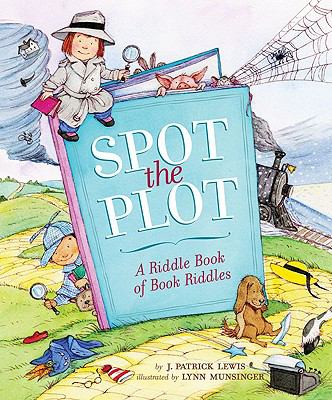
Spot the Plot: A Riddle Book of Book Riddles by J. Patrick
Lewis
I included this one just because it is fun. This is a collection of poem riddles about classic children's literature. You read the poem and try to guess the book it refers to. The answers are in the back of the book but most people will be able to answer without consulting the back. Lynn Munsinger's illustrations add more clues. This book shows how a few of the best children's books really have touched all of our lives.
The other one I highlighted was Book Speak: Poems about Books by Laura Purdie Salas, but that is one I reviewed for SLJ, so I won't include a review here. You can google my name and the title and find the review I wrote for SLJ.
Lemonade and Other Poems Squeezed from a Single Word by Bob Raczka
Sometimes we think about poetry as an old and venerated form of literature, but there are
creative souls out there who are still thinking of new things to do with words. In this book, Raczka takes a single word, and uses the letters from the word to form other words. Then he uses those words to create a free verse poem. In the book, the typesetting is very clever. The poem is presented twice, once vertically with the letters dripping or tumbling below the original word to show how the new words were arranged, and again in normal horizontal form, so it is easier to read. Some of the resulting poems aren't so great, but some are not bad, "Halloween/ all alone/ an owl/a howl/ oh no".A Dazzling Display of Dogs: Concrete Poems by Betsy Franco
In this book, the text of the poems is fully incorporated into the
illustrations. It is hard to explain without actually seeing the illustrations. For example, for the poem, Baloo Got Out, the dog gets out of the gate and eats a bunch of stuff he was not supposed to. The list of things he ate appears in the dog's belly, on illustrations of each item. The illustrations are busy, bright and fun. The thing that impressed me the most, however, is almost all the poems rhyme and scan. Usually concrete poetry is free verse. I guess poets think it was hard enough to make the poem have visual impact, that they aren't going to worry about rhyming too. But Franco, and the illustrator, Michael Wertz pull off both.
Emma Dilemma: Big Sister Poems by Kristine O/Connell George
This one doesn't have any clever gimmicks. It is just a collection of sweet poems about a little sister. The poems explore the full range of emotions one might feel about a younger sibling, from affection to embarrassment to jealousy. The poems are honest, but never bitter and often tender. Nancy Carpenter's illustrations are also sweet, and match the tone of the peoms
Spot the Plot: A Riddle Book of Book Riddles by J. Patrick
LewisI included this one just because it is fun. This is a collection of poem riddles about classic children's literature. You read the poem and try to guess the book it refers to. The answers are in the back of the book but most people will be able to answer without consulting the back. Lynn Munsinger's illustrations add more clues. This book shows how a few of the best children's books really have touched all of our lives.
The other one I highlighted was Book Speak: Poems about Books by Laura Purdie Salas, but that is one I reviewed for SLJ, so I won't include a review here. You can google my name and the title and find the review I wrote for SLJ.
Thursday, January 6, 2011
Mirror Mirror: a Book of Reversible Verse by Marilyn Singer
This one wins the prize for the most clever poetry book of the year. In this book the author writes a free verse poem (really, just a few well crafted sentences) that can then be read with the lines of the poems in reverse order. The first poem tells about a fairy tale from one character's point of view, and the other (the reverse one) tells the story from another character's point of view. No kidding. For example, in the poem about Red Riding Hood, the last few lines of the first poem say,"picking berries to eat-/juicy and sweet/what a treat!/ But a girl/mustn't dawdle./ After all, Grandma is waiting." and then the first few lines of the next poem (the Wolf's poem) "After all, Grandma's waiting./mustn't dawdle.../But a girl!/ What a treat-/juicy and sweet./picking berries to eat." Isn't that wicked? The illustrations are cool, too. They are each divided in half, each half showing one of the points of view, but still related to each other. If I were to actually purchase a poetry book this year for myself, this is the one I would buy.
R is for Rhyme: a Poetry Alphabet by Judy Young
Back to the poetry books. You can find an alphabet book about almost anything under the sun, so why not poetry? For each letter of the alphabet Young chooses a vocabulary word related to poetry. Most of the words are forms of poems, like haiku for H and cinquain for C. A few of the vocabulary words are poetic devices, like end rhyme for E and onomatopoeia for O. For each vocabulary word, Young provides a poem that contains or is an example of the word, and a three to four paragraph explanation of the term. Now, last summer, as my blog readers know, I did a poetry study with my kids, and I can tell you, I wish I had known about this book when I did that study. The poems in the book are decent, but the explanations and the variety of terms is very impressive. If there were someone who, like me, wanted to study poetry at home, they could get this book, take a letter a week, and there would be half a year of poetry lessons. The book is illustrated with full color, pastel drawings that are slightly stylized and fairly amusing. (about 56 p)
Sunday, January 2, 2011
Guyku: a Year of Haiku for Boys by Bob Raczka

One form of poetry all children learn at school is haiku. In fact, my children studied haiku several different years, and by the second or third, they were pretty tired of it. They would just roll their eyes, and then start spouting spontaneous horrible haiku at the dinner table. (I am thinking mostly of Benjamin, who often spouts poetry spontaneously). So why am I highlighting a haiku book on my top 5? Well, like all forms of poetry, there is good haiku and bad haiku, and this is actually pretty good haiku. What makes it fun is that with his haiku Raczka shines a flashlight, so to speak, on wonderful experiences of growing up a boy. He talks about all the simple pleasures boys (and girls) do when they have all the time in the world and live in a world that is safe and inviting. The poems are arranged by seasons. In "spring"he talks about catching a grasshopper, riding a bike and flying a kite. He talks about climbing trees in summer, playing in leaves in fall, throwing snow balls, and hiding under a snow laden pine tree in winter. I remember doing all that kind of stuff when I was a child and I hope children still go outside and enjoy nature that way. The book is illustrated with very simple cartoon drawings colored in with understated pastels. The text is printed in a large, child friendly font. I think the idea there was to focus attention on the words, not just on the illustrations. For adults, the book is nostalgic, and for children, I hope it will give them some ideas of what to do beside playing computer games.
Saturday, January 1, 2011
The Dark Emperor & Other Poems of the Night by Joyce Sidman

Here is a more serious poetry book that couples really good writing with lovely illustrations. Sidman has written 12 poems about the night in a forest. Some are about animals, and others about trees or the moon. Some of the poems are rhymed and metered, while others are free verse or concrete poems. The rhyming poems are really well done, with careful attention to meter and form. The free verse poems are also good with sensitivity to the sound and rhythm of the words. A good poet manages to make the words flow naturally, and you never get the sense that they were forced into a certain word choice by the structure of the poem. Sidman pulls this off really quite well.
Each of the poems are accompanied by a beautiful illustrations done using the technique of etching. The artist puts down color, and then covers it with a black overcoat. Then he (Rick Allen in this case) scrapes away some of the black to reveal the color beneath. It is a good technique for a book about the night.
Finally, each spread had an information paragraph about the subject of the poem. The informational paragraphs are written in prose, but they is well crafted, and almost poem-like. They contain some interesting facts that I had never heard before. The three elements combined--the good poetry, lovely illustrations and interesting information paragraphs--make this probably my top pick of my top five.
Thursday, December 30, 2010
Family Literacy Symposium Titles
On January 22 our library will be holding a Family Literacy Symposium. The Keynote speaker is Leif Enger, author of Peace Like a River. As part of the symposium the Children's Department is offering a presentation of "The Best Books of 2010." Each of the Children's staff were asked to choose a few books from the section for which they order to showcase in the presentation. Since I order the 800's (poetry and joke books, mostly) I chose 5 poetry books as my picks. You, oh faithful readers of my blog, get to have a sneak peak at them. I won't blog them all today, or I would be up to late, but I will get to them over the next day or so.
Subscribe to:
Posts (Atom)