Showing posts with label Teen Nonfiction. Show all posts

Thursday, January 8, 2026

Everything Sad is Untrue by Daniel Nayeri

 As Khosrou struggles to find a place for himself in Oklahoma, he remembers stories from Iran: his own story, stories of his family, and Iranian legends.  As he shares his stories with his class, they don't know what to believe and what not to believe.  His own life seems as fantastic, amazing, and cruel as the folktales of his culture.  Nor are his struggles over.  His stepfather is sometimes violent, and so are some of the bullies at his school. Although his mother was a doctor in Iran, they now struggle to get enough food and to meet basic needs.  He keeps a notebook where he writes ways that he has learned to cope, and clever things to say to the girl he likes, who thinks he is scum.  Through it all, thoughts of his heroic mother, his affectionate grandfather, and his absentee father help him make it though, one day at a time.

I didn't realize when I checked out this book that it was the winner of the Printze award for outstanding teen literature the year that it came out. The book is formulated kind of like the tales of Scheherazade.  The author jumps from the past to the present, from folklore to reality with the turn of the page.  As I read, I wondered how much of the story was based on Nayeri's own experience. An afterword explains that it all was.  He admits that his memory might have been inaccurate, but every cruel thing that happens to Khosrou is something he experienced. The reader should be warned that this is a hard tale to hear, though Nayeri does a good job of sticking in a funny story after a heavy one to the the book is much less depressing than it could have been.  It is the kind of book that sheltered white kids should read so that they can get a perspective on what it is like to be a refugee from a different culture in America. I could see a kid being assigned to read the book, expecting to hate it, but ending up really liking it. Hopefully they would become a better person from the experience. (368 p. 2020)

Tuesday, December 16, 2025

Nature Poems to See By: a comic artist interprets more great poetry (illustrator) Julian Peters (Net Galley)

 This is a collection of 24 famous poems that have been illustrated or presented in the style of a graphic novel. The poems are arranged by seasons, with six poems for each season, and most would be familiar to anyone who has ever studied poetry, like "Shall I Compare Thee to a Summer's Day" by Shakespeare, and "Stopping by the Woods on a Snowy Evening," by Robert Frost.  Peters seems to make an effort to include poems from different time periods and a few different cultures, though most are from Western authors. Some of the illustrations are more like graphic novels, with one frame per each couplet, while other seem more like true illustrations, with a lot of words associated with one picture.  Some of the poems are illustrated literally, and in other cases Peters tries to suggest symbolic meanings implied by the poems. At the end of each graphic novel depiction of a poem, the poem is also printed in  traditional font and format.

I received this book as a pre-print from the publisher, Plough.  It has been a while since I have read a poetry collection and I thought that expressing poetry in graphic novel format is an interesting idea. As it turned out I generally liked the book, but I liked some treatments of the poems better than others. I preferred illustrations that did a literal depiction of the poem instead of trying to tie in symbolic meaning.  If a poem has veiled symbolism, one of the charms of reading the poem is trying to figure out the symbolism, or maybe trying to find personal meaning in the symbolism.  The artist, by depicting his symbolic interpretation of the poem, steals from me the experience of creating my own interpretation. That being said, if I were a high school student and needed to interpret a poem and found this graphic novel version on it, I could be pretty excited about it. I actually think teens, particularly English/reader nerd types, are the perfect target audience for this book.  I could also see a high school teacher using one of these illustrated poems as a springboard for a good discussion. If I were a high school English teacher, I would definitely want a copy on my classroom shelf. (2026, 141 p.)


Saturday, November 29, 2025

The Mona Lisa Vanishes by Nicholas Day

 The Mona Lisa is perhaps the most famous painting in the world, but back in 1910, it was just one of many great artworks in the Louvre Museum in Paris. What catapulted it to world wide fame? It was stolen. This is a children's nonfiction book about the 1911 heist of the Mona Lisa and how it affected the popularity of DaVinci's masterpiece.  It also gives a decent summary of DaVinci's life, and the place of the Mona Lisa in his career. The books ends with the surprising capture of the Mona Lisa thief, and the consequences that befell him. 

When I checked this out I thought it was a children's mystery fiction, but it turned out to be a really well written and entertaining nonfiction.  The tone of the narrative is snappy and informal. Day includes a lot of interesting facts about Paris, the Louvre, and the state of the world in the early 20th Century. He also talks about DaVinci in a not-too-flattering way, that is also engaging and amusing. The reader should beware that Day includes a lot of subjective social commentary in his narrative. This would be a great book for teachers of homeschoolers who want to mix literature with other subjects, like humanities or history, and also have a lot of interesting social questions to discuss. I am not surprised it won the Siebert Medal for children's nonfiction when it came out. (2023, 288 p) 

Sunday, November 20, 2022

Quiet Power by Susan Cain

 This is the "young reader" version of "Quiet: The Power of Introverts in a World that Can't Stop Talking" (why do nonfictions always have to have long titles?).  I didn't read the adult one, but this one is excellent.  It gives both introverted and shy kids tips on how to survive, cope, and thrive in a world that often rewards extroverts.   There are different sections on dealing with teachers, peers, taking leadership roles, doing sports, and dealing with family members.  Cain doesn't portray introversion as a challenge to be overcome, but as a strength to be exercised. As I read the author's advice, I kept thinking of myself as a child, but also about the children I know who struggle with shyness.  I especially liked the part at the end when the author gives ideas to parents and teachers how to make subtle changes in home and class management to help introverted children thrive.  (2016, 288 p)


Friday, October 21, 2022

Norse Mythology by Neil Gaiman

 Neil Gaiman takes diverse tales of Norse Mythology and weaves them into a single narrative. He starts with creation myths, and then focuses on the adventures of Odin, Thor and Loki. He includes origin stories, trickster tales, and battles with various giants. He finishes the books with the traditional predictions of Ragnarak with its portent of utter destruction followed by rebirth. 

It is hard to think of anyone better to retell Norse Mythology than Neil Gaiman. He is is an amazing storyteller and never shies away from gruesome or shocking details.  He does a great job portraying the personalities of the various gods as he sees them.  Odin, is obsessed with obtaining knowledge is will to sacrifice anything to get it.  Thor is basically good hearted, but brutish and not very bright.  Loki is the most clever, but is without morals.  He is as likely to kill another god as to help him/her. Gaiman includes a lot of humor, some of it very irreverent.  In fact, I had a hard time deciding for what age group this book would be appropriate. Much of it would be super engaging to upper elementary and middle school readers, but there is some open discussion of adultery and sexual promiscuity. They are, after all, essential elements of the mythology.  I think I would probably put the book in the teen nonfiction section, but I would be willing to suggest it to less sheltered 6th or 7th graders.(2017, 304p.)

Saturday, April 24, 2021

Gone to the Woods by Gary Paulsen

 This is a new memoir about the life of the hugely successful author, Gary Paulsen.  This one deals with his very early childhood up to his time in the military.  At the age of five he was put on a train and sent to live with his aunt and uncle on a farm.  It was a happy time and there he learned to feel at home in the woods.  Then he talks about living in Manila while his father served on a military base there.  His parents were so caught up in alcohol and fighting that Paulsen was left to live like a street kid. His parents' neglect and abuse of him and each other continued into his teen years, but he was greatly influenced by a kind librarian who first encouraged him to write. The final part of the book talks about his time in the military and how he decided to leave his military career in the end.  

I have had the great fortune to hear Gary Paulsen speak to a small group of librarians.  I had heard some of these stories before, and some were new to me.  He is a very interesting man who has lived a life more incredible and intense than any of his amazing books.  Even though he was treated so badly as a child, he grew up to be a man with a mischevious smile and a twinkle in his eye as he tells some of his many adventures.  I am glad he wrote this book, even though it has some hard realities in it.  There are kids out there who are living their own hard realities, and maybe this book will give them a sense of kinship and hope that there may still be good things ahead, even if they are in a bad place right now. I must add a warning that this is not a great choice for a kid that is sensitive and easily upset.  I probably wouldn't give to anyone under 12 unless I thought they particularly needed it. (368 p. 2021)

Tuesday, April 28, 2020

The Stupid Crook Book by Leland Gregory

This book is just what you would suppose.  It is a collection of very short stories about stupid things criminals have done.  The stories mostly fit one to a page, and are sometimes accompanied by wacky illustrations.  The stories are taken from places across the globe and often the author mentions his source.  This could be a great book for a reluctant reader, or just to place on the coffee table to pick up and read for fun now and then. The book is written for adults, but could be enjoyed by teen boys.  There is a little bit of innuendo, but it is super subtle. (231 p 2002)

Tuesday, April 14, 2020

Funny, You Don't Look Autistic by Michael McCreary

Michael McCreary was diagnosed as autistic at age 5.  Now in his early 20's he does autism themed stand-up comedy across Canada. This is a lighthearted but candid look at what life was like for him growing up on the spectrum.

I listened to this book because it is Overdrive's Big Library Read title.  I think it is an interesting choice.  McCreary tells funny stories from his growing up years, but also elucidates life as an aspie in a very accessible way.  He thinks of himself, primarily as a comedian, but also accepts the fact that he is an advocate for people with Autism and their families.  He is high functioning, but his brother, who also had Autism, was more severely challenged, so McCreary has a good perspective on the wide range of experience of people on the Spectrum.  If someone had not really investigated Autism before, this book could be really eye opening. I must admit that it wasn't as funny as I expected, but it was uplifting and well worth the short time it took to read.  (2019, 176 p.)

Friday, April 3, 2020

Hey, Kiddo by Jarrett J. Krosoczka

Some people are born into wonderful families where parents provide a loving and stable environment where their children can thrive.  Jarret was not born into one of these families.  When he was a toddler, he mother barely functioned and he had no idea who his dad was.  His grandparents took custody of him when he was three, but even in their home he was surrounded by fighting, smoking and alcohol.  As he grew older he found out that his mother struggled with drug addiction, and was in and out of either treatment or jail. Embarrassed by his family, he found escape through art.  Luckily his grandparents encouraged him and he went on to become a successful children's book illustrator.

This is a memoir in graphic novel format.  It got tons of great reviews the year it came out, and for good reason. It is powerful and unflinchingly honest.  I can see how reading it could make kids in similar situations feel they are not alone, and kids with happy families feel grateful for what they have.  Krososzka is not only telling his story, he is sharing his woundedness with amazing courage. The reader should know that there are difficult situations and quite a bit of gritty language in the book, so if that bothers you, this is one to avoid. (320 p. 2018)

Saturday, April 27, 2019

The Greatest Treasure Hunt in History by Robert M. Edsel

Adolf Hitler and his second in command, Hermann Goering, both had an insatiable appetite for collecting fine art and cultural treasures.  As they invaded European countries during World War II they helped themselves to art collections of private citizens and public museums.  One American art professor, Frank Stokes, proposed to President Roosevelt that a military unit be created that could oversee the protection and recovery of cultural treasures during the war.  Stokes was appointed to head up the unit which initially consisted of only 11 men, most with art or architecture preservation backgrounds. Initially they just followed in the wake of advancing armies, trying to figure out what had been destroyed, stolen, or damaged, but later they actively searched for the Nazi treasure troves that Hitler and Goering had established to store their ill gotten gains.

This is a new Young Readers' Edition of the book The Monuments Men that was made into a major motion picture in 2014.  The chapters flip from one Monument's Man to another, each stationed in a different region, and follows their successes and failures month by month, from 1943 when they arrived to after the end of the war.  The information was super interesting to me as a humanities major, and I was able to relate with the horror these men felt when they found the world's most famous art damaged, or poorly protected. That said, I am not sure what child or teen would be interested in this book. I think the best audience for this book are adults who kind of wanted to read The Monuments Men but were daunted by its nearly 500 pages. With this book they can get a "cleaned up" version that's about 150 pages shorter. (2019, 333 p.)

Sunday, January 13, 2019

Endurance: Young Reader's Edition by Scott Kelly

Cover image for Endurance : my year in space and how I got thereScott Kelly is the American astronaut who has spent the most time in space.  This engaging and inspirational autobiography traces Kelly's life from the time that he was a high energy boy who struggled in school, through his stormy college experience, and on to his very successful career.  He then recounts in detail what his experience was like during his last-year long stay on the International Space Center. The tone of the narrative is informal and accessible.  Kids that are even a little fascinated by space travel will enjoy hearing what it was like to be on both the Space Shuttle and the Space Station.  Kids who currently struggle to sit still at school will be inspired by the fact that Kelly had similar struggles, but eventually learned how to study well and get good grades in college. This is a "young reader's edition" but it is only 70 or so pages shorter than the adult version. That said, it is clearly written with kids and teens in mind. (2018, 317 p.)

Saturday, December 8, 2018

Samurai Rising : the epic life of Minamoto Yoshitsune by Pamela Turner

Cover image for Samurai rising : the epic life of Minamoto YoshitsuneYoshitsune was one of Japan's most famous Samurai.  He was bold, reckless, and a fierce and cunning warrior.  This engaging biography recounts his life and the complicated warlord culture of 12th century Japan.  Turner does a good job of making the arcane time period accessible. It is no surprise it won a boat load of awards the year it came out. I especially liked some of her analogies to modern life e.g. when she said that Yoshitsune was like the star quarterback, but his older half brother was like the owner of the team.  Her biography is carefully researched, and she mentions her sources in text and in an author's note at the end.  Medieval Japan was a cruel and violent place, and Turner doesn't shellac any of the graphic details of her heroes' exploits.  This is not a good choice for the squeamish at heart.  It might be a great choice for a teen who loves action video games and is required to read a bio of a historical figure.  (2016, 236 p.)

Wednesday, December 5, 2018

The Boys in the Boat: Young Reader Adaptation by Daniel James Brown

Cover image for The boys in the boat : the true story of an American team's epic journey to win gold at the 1936 OlympicsJoseph Rantz started life as a normal kid in a normal working class family.  All that changed when his mother died and his father remarried.  Joe's step mother didn't like him, and by the time Joe was 15, he was kicked out of the house and fending for himself.  He managed to earn enough money to go to one semester at Washington University, where he tried out for the rowing team.  His hope was that if he got on the team he would be able to also get a job working in the athletic department and earn enough money to stay in school.  The place on the rowing team lead him to more than a job; it eventually lead to a gold medal in the 1936 Olympics.  More importantly it taught him that he could trust people and risk being part of something again.

When this book first came out in 2015 it got a lot of attention from review journals.  It is a well written and inspirational story of young men who get through life by working together and pushing themselves.  I actually didn't like it quite as well as Steve Sheinkin's Undefeated.  Brown's descriptions of Joe's struggles and the team's efforts to pull together are great, but his attempt to tie it in with all that was going on with the rise of Hitler is a bit tenuous.  Still, it is a engaging book, and I never got bored reading it. It would be a good choice for a junior high-age-boy who is a reluctant reader but likes sports and has to read a historical nonfiction book. (or for adults who were kind of interested in the original version, but don't want to wade through 400 pages of a sports narrative.)(2015, 240 p.)

Thursday, November 29, 2018

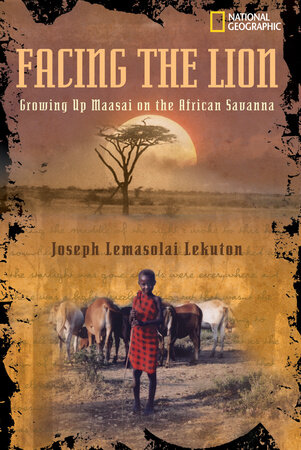
Facing the Lion: Growing up Maasai on the African Savana by Joseph Lemasolai Lukuton

Facing the Lion by Joseph Lemasolai Lekuton and Herman ViolaJoseph starts life in a nomadic Maasai tribe. His tribe keeps cows, and moves from place to place to find adequate food and water for their herds. When the government requires each family to send one child to school, Joseph, who was sometimes teased because he is chubby, volunteers to go.  School introduces Joseph to the outside world, and as he advances as a student, his view of the world grows.  Despite his broadening horizons he clings to his Maasai culture and family.

This is a fascinating autobiography.  The language is simple and direct, but the reader can feel Joseph's pride in his culture, and longing to be a brave as the great warriors of his people.  So often people in modern cultures feel that they are superior to tribal groups, but Joseph's story shows that the people in his tribe, despite the challenges of finding basic subsistence, live happy lives full of meaning and purpose.  This is a great book to give to a children who like, (or need) to learn about people who live very differently from themselves. (2005, 125p)

note: Amazon lists this book as appropriate for ages 12 and up.  That is probably because of the chapter that describes the circumcision ceremony men in Joseph's tribe undergo as a rite of passage.  I would feel comfortable giving it to a 5th or 6th grade child, as long as their parent was aware of that chapter and could answer questions about that for them.

Wednesday, October 17, 2018

The Beloved Life of Sonia Sotomayor (autobiography)

Cover image for The beloved world of Sonia SotomayorThis is a children's version of an autobiography published by Sotomayor in 2013. It chronicles Sotomayor's early childhood as a type 1 diabetic in the projects in Brooklyn, her upbringing by a single mother, her acceptance at Yale and then at Harvard, her career as a DA and corporate lawyer, and her final confirmation as a district judge.  It is a very inspiring story told with engaging prose and endearing candor.  Sotomayor is modest in her account, expressing surprise at each honor she received.  She talks about turning points and how she learned from mistakes.  She is an amazing example of someone who took on each challenge with unflagging effort and enthusiasm.  I think this book would be a great choice to give to girls who have that extra spark of ambition and ability.  (2018, 343 p.)

Thursday, July 5, 2018

The Playbook by Kwame Alexander

Cover image for The playbook : 52 rules to aim, shoot, and score in this game called lifeThis is a nonfiction companion to Alexander's Newbery winning book, The Crossover.  It is a collection of advice about basketball and life, supported by examples and quotes from famous people, mostly black athletes but including some whites, and some non-athletes, like Michelle Obama and Sonia Sotomayor. The advise is solid, and is couched in sports terminology to appeal to a young athlete.  Alexander also includes some autobiographical stories of how he came to embrace and succeed in tennis and what he learned from that. Alexander's examples from the lives of famous people are well chosen and inspirational. They are illustrated with photographs of the people who are quoted/highlighted. This would be a great book to give to a reluctant reader athlete as a gift or as part of a recognition.  (2017, 169 p.)

Sunday, December 31, 2017

Undefeated by Steven Sheinkin

Cover image for Undefeated : Jim Thorpe and the Carlisle Indian School football teamJim Thorpe was the son two mixed American Indian/European parents. He attended the Carlisle Indian School which had as its purpose to eradicate the "Indian" part of its students. Jim hated school and often ran away, until he was recruited to be on the school's track team.  From there he joined the football team and under the coaching of Pop Warner, the team became one of the best collegiate teams in the country. Recognizing Jim's amazing athletic talent, Warner encouraged Jim to try out for the 1912 Olympic team.  He made it onto the team and ended up winning the gold in the pentathlon and decathlon. Soon afterward, his medals were stripped from him when it was discovered that he had played minor league baseball, and was therefore considered a professional instead of amateur athlete. He, nevertheless, went on to play professional baseball and then helped start the National Football League.

I have very little interest in sports in general, and football in particular, so the fact that I really enjoyed this book, even though it is rather long, is a testament to Sheinkin's writing skill.  Sheinkin talks about the effects of the cultural annihilation practiced at the Indian schools at the time.  He also explores the complicated relationship between Pratt, the head of the Carlisle School, Pop Warner, the coach, and the students like Thorpe.  He spends a lot of time describing how Warner helped football evolve from an unrestrained brawn brawl on the field to the complex and much safer game it is today.  It really was a fascinating read and I am sure I will be recommending it to the sports kids that come into the library. (2017, 280 p)

Wednesday, February 6, 2013

Bomb: The race to build-and steal-the world's most dangerous weapon by Steve Sheinkin

To my credit, I had this book checked out and was half the way through it before it won every major ALA youth nonfiction award last week.  Every award was well deserved.  This was the most gripping nonfiction I have ever read. The author used to be a text book writer, and he notes in the back cover fly leaf, that he is "making up for his previous crimes by crafting gripping narratives of American history." If all history was written like this, history would be every child's favorite topic at school. This is the story of the Manhattan Project from the point of view of a variety of people involved.  It also follows the work of spies from five nations who were trying to either steel the technology from the US or prevent Germany from developing their own bomb.  I am as well versed on the history of the Manhattan project as anyone, having lived, and my husband having worked, at Los Alamos for a summer. But I never realized how amazing successful the Soviet government was in infiltrating the project.  Soon after the first successful test of the bomb at Trinity, spies inside the inner circles at Los Alamos had given complete plans for the bomb to Soviet agents. One of my favorite spy factoids was that at one point one of the agents used milk to write the technical information on a newspaper.  Every cub scout has written a secret message in milk or lemon juice and then made it appear by heating it.  It is amazing the spies used such a simple tactic to steel information that created the whole cold war. Anyway, this is a must read for adults and older children.  It might be too frightening for kids under 11 or 12, because it really brings to high relief the reality of the nuclear threat that still exists in the world. (266 p)